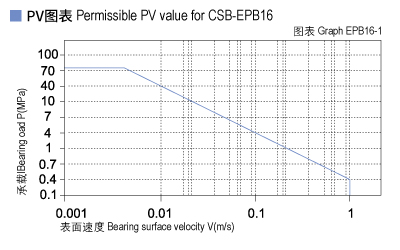
The max PV value of the CSB-EPB16 plastic bearings is 0.4N/mm2×m/s which determines the load capacity of bearing is inversely proportional to the speed. Please refer to the chart for more detailed information (Graph EPB16-1).
▊ Load, speed and temperature
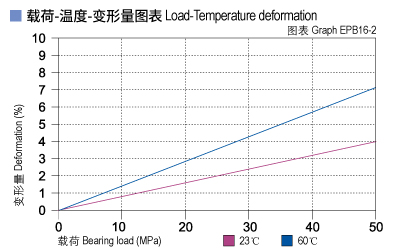
CSB-EPB16 allows the Max static load of 75Mpa, The max compressive deformation rate under the max load is listed in Graph EPB16-2, The actual load capacity of bearing is slightly less than 75Mpa, The bearing load is variable against the speed and temperature, Fast speed (Vmax: 1.0m/s) results into higher temperature (Tmax: 130℃) which decreases the load capacity of the bearing. Please refer to the Graph EPB16-3 for such variation.
▊ Friction factor, wear and shaft material
▊ Friction factor
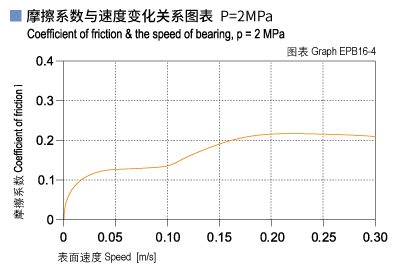
Graph EPB16-4 shows that as the same as most of the slide bearing materials, the friction factor of CSB-EPB16 is increasing along with the rotation speed under a certain loading while as shown in Graph EPB16-5, it is decreased along with the increasing of loading when the operation speed is stable. From Graph EPB16-6, it is found that the most suitable shaft roughness is Ra0.1 to Ra0.2. Smoother shaft or rougher shaft may result into friction factor increasing.
CSB-EPB16
Dry
Grease
Oil
Water
Friction coef. μ
0.06~0.20
0.09
0.04
0.04
▊ Wearing and shaft material
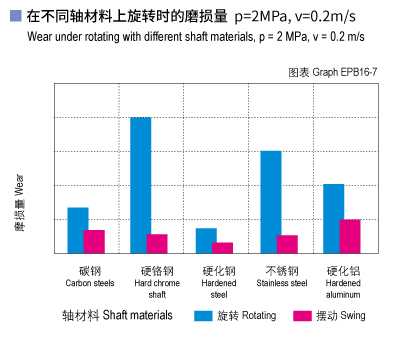
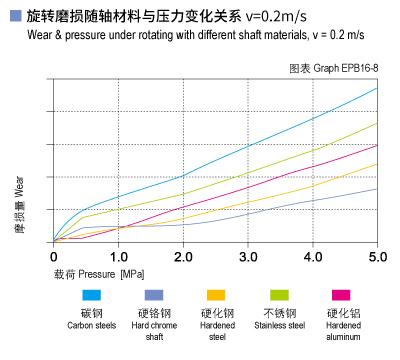
Graph EPB16-7 and Graph EPB16-8 shows the wearing is considerably affected by the shaft materials. Heat-treated steel shaft and carbon steel shaft is good for this bearing material. CSB-EPB16 is suitable for hardened chrome steel and hardened steel shaft in oscillation operation and is suitable for carbon steel and hardened steel shaft in rotation operation.
▊ Chemical resistance
CSB-EPB16 is good at chemical resistance against weak acidic medium and various kinds of lubricants.
▊ Water absorption
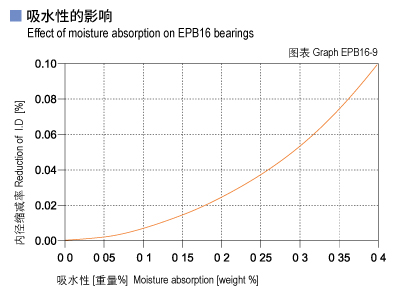
The moisture absorption of CSB-EPB16 plastic plain bearings is 0.2% in standard atmosphere. The max. water absorption is 0.4% in water . These values are very low, CSB-EPB16 plastic palin bearings is very well suited for used in wet applications.
▊ UV resistance
Disintegration could be possible for the material CSB-EPB16 after long period of exposing under the UV ray and therefore the performance of the material will be reduced.
▊ Installation tolerances
CSB-EPB16 Tolerances after pressfit
Diameter [mm]
CSB-EPB16 E10 [mm]
Housing H7 [mm]
Shaft h9 [mm]
>0~3
+0.014~+0.054
0~+0.010
0~-0.025
>3~6
+0.020~+0.068
0~+0.012
0~-0.030
>6~10
+0.025~+0.083
0~+0.015
0~-0.036
>10~18
+0.032~+0.102
0~+0.018
0~-0.043
>18~30
+0.040~+0.124
0~+0.021
0~-0.052
>30~50
+0.050~+0.150
0~+0.025
0~-0.062
>50~80
+0.060~+0.180
0~+0.030
0~-0.074
>80~120
+0.072~+0.212
0~+0.035
0~-0.087
>120~180
+0.085~+0.245
0~+0.040
0~-0.100
Medium
EPB16 bearings resistance
Alcohol
Resistant
Hydrocarbons
Not resistant
Greases. oils
Resistant
Fuels
Resistant
Diluted acids
Conditionally resistant
Strong acids
Not resistant
Diluted alkalis
Not resistant
Strong alkalis
Not resistant
CSB® Bearing Material Chemical Resistance
Please select bearing material and medium...
R - Resistant
CR - Conditionally resistant
NR - Not resistant
ND - No test data
RD - Resistant,but the dimension changed due to moisture absorption
NO - No data
CSB® bearing material chemical resistance data is a comparison test result of the CSB chemistry laboratory using laboratory specimens or similar chemicals at room temperature 23 ℃, without considering the impact of other temperatures and chemical medium mixtures on the chemical resistance of CSB® bearing materials ; Therefore, this data can only act as a reference. CSB® recommends that the chemical resistance of actual parts should be tested under application conditions and verify the suitability of the bearings.
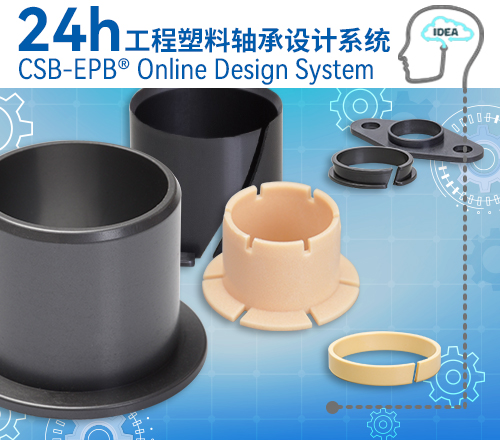
▊CSB-EPB® Plastic Bearings Finder[V2.1] is based on the analysis and calculation of a large number of test data in CSB® laboratory. You can calculations material data by entering parameters such as bearing load, speed, and temperature, and finally output material adaptation data. ▊Because the system calculate and analyze based on lab data, it can't exactly meet the ractual use requirements absolutly. The system data verification has certain limitations; CSB® recommends that the bearing must be tested again to verify whether it meets the actual use requirements. ▊CSB-EPB® Plastic Bearings Finder output data information is only for design reference, and can not be used as the final standard for determining the bearing material conformity, If you have any questions, please contact CSB® sales engineers.
CSB-SFP®
Semi-finished Products Finder V2.0
view tools
DURAPLAS® Semi-finished Products Finder V2.0
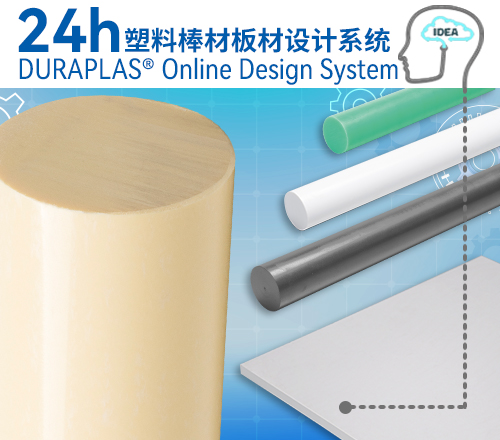
▊DURAPLAS® Semi-finished Products Finder[V2.0] is based on the analysis and calculation of a large number of test data in CSB® laboratory. You can calculations material data by entering parameters such as bearing load, speed, and temperature, and finally output material adaptation data. ▊Because the system calculate and analyze based on lab data, it can't exactly meet the ractual use requirements absolutly. The system data verification has certain limitations; CSB® recommends that the products must be tested again to verify whether it meets the actual use requirements. ▊DURAPLAS® Semi-finished Products Finder output data information is only for design reference, and can not be used as the final standard for determining the bearing material conformity, If you have any questions, please contact CSB® sales engineers.
Low friction and good wear resistance for high temperature applications. The excellent chemical resistance of the material ensures athe applications for high temperature and high chemical erosion applications.
A self-lubricating material with low water absorbtion. Good wear resistance will be maintained when used with soft shaft and hard shaft combined. Continuous working temperature: -40℃/+100℃