27

2026-08

What are the core performance features of DURAPLAS® self-lubricating engineering plastic bearings, and which industries are they primarily suited for?

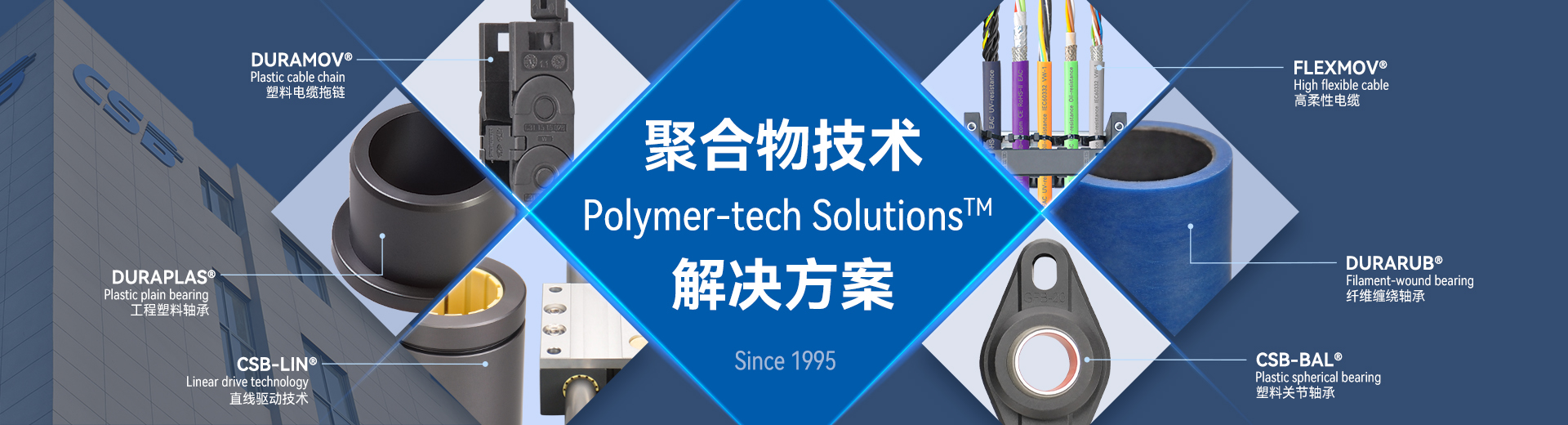
DURAPLAS® self-lubricating engineering plastic bearings use modified engineering plastics as the core base material, with solid lubricants compounded within the polymer matrix to achieve fully dry-state self-lubrication without the need for grease replenishment or maintenance. The products feature a low coefficient of friction, excellent resistance to dust and debris ingress, high wear resistance, low operating noise, and a certain degree of impact resistance. They can operate continuously within a temperature range of -40°C to 110°C, with selected grades offering food-contact compliance and resistance to weak acids and alkalis. The material is significantly lighter than metal bearings, enabling overall weight reduction, while also tolerating a certain degree of assembly misalignment and lowering precision requirements for machining and assembly. This product series is widely used in automation equipment, logistics sorting systems, food packaging machinery, medical devices, photovoltaic equipment, household appliances, AGV vehicles, and other fields. In food packaging equipment, they eliminate the risk of grease contaminating products; in logistics sorting systems, they operate reliably in dusty environments and reduce equipment maintenance frequency; in household appliances, their low-noise characteristics enhance the overall user experience. They are the preferred bearing solution for medium-to-low load reciprocating oscillation and rotational motion scenarios.

27

2026-08

How should one choose between DURAPLAS® engineering plastic bearings and TEFPLAS® fluoroplastic bearings, and what are their respective performance differences and application scenarios?

DURAPLAS® engineering plastic bearings offer outstanding overall cost-performance, with modified engineering plastics as the main matrix and embedded solid lubricating components. They are suitable for medium-load, conventional-temperature operating conditions, delivering excellent wear resistance and strong impact resistance, but have limitations when facing highly corrosive or ultra-high-temperature environments. TEFPLAS® fluoroplastic bearings use fluorine-based polymers as the core base material, characterized by exceptional chemical corrosion resistance—withstanding strong acids, strong alkalis, and organic solvents—a broader temperature tolerance range, capability to handle high-temperature conditions, and an extremely low coefficient of friction, making them ideal for harsh chemical-media environments. In comparison, DURAPLAS® is predominantly used in general automation, conveying equipment, and general machinery; TEFPLAS® fluoroplastic bearings are primarily used in chemical equipment, electroplating equipment, wastewater treatment systems, semiconductor equipment, and other machinery exposed to highly corrosive media. When equipment involves chemical spraying or immersion conditions, TEFPLAS® fluoroplastic bearings should be prioritized, while DURAPLAS® is preferred for conventional conditions to control overall equipment costs.

27

2026-08

What are the performance differences between CSB-LIN® plastic linear bearings and traditional ball linear bearings, and what types of equipment are they suitable for?

CSB-LIN® plastic linear bearings eliminate the ball rolling structure, relying on high-molecular wear-resistant materials to achieve sliding linear motion. Their core performance advantages include dust and debris resistance, direct washdown capability, no risk of ball seizure or failure, low operating noise, light weight, tolerance for a certain degree of misalignment, and fully maintenance-free lubrication. Their limitation is that the maximum operating speed is lower than that of ball linear bearings, making them unsuitable for ultra-high-speed continuous operation. Traditional ball linear bearings can achieve high-speed motion but require high environmental cleanliness; dust can easily cause ball wear and seizure, necessitating regular grease lubrication. CSB-LIN® plastic linear bearings are extensively used in automated transfer mechanisms, packaging equipment, 3C electronics equipment, warehousing systems, and medical devices. They are particularly suitable for equipment operating in dusty environments where regular maintenance is inconvenient—for example, reciprocating slides in packaging production lines and sliding modules in medical testing equipment—where they eliminate the risk of grease contamination.

27

2026-08

What key performance features do CSB-BAL® plastic spherical plain bearings offer, and what pain points in mechanism design do they primarily address?

CSB-BAL® plastic spherical plain bearings possess inherent self-aligning compensation capability, which can offset coaxiality errors introduced during assembly and counteract edge loads generated during mechanism operation, preventing localized stress concentration that causes rapid component wear. The products feature a self-lubricating composite structure, require no grease injection, offer corrosion and salt spray resistance, and are available in both composite-material-base and stainless-steel-base versions. They provide a large oscillation angle and are suited for reciprocating hinged oscillating motion. Mechanism design frequently encounters assembly misalignment in multi-bar hinge structures; metal spherical plain bearings require regular grease maintenance and are prone to rust and seizure in harsh environments. CSB-BAL® plastic spherical plain bearings are widely used in humanoid robot joints, automated hinged tooling, construction machinery auxiliary mechanisms, agricultural machinery, and hinge points in new energy equipment. At the connecting rod hinge positions of humanoid robots, they enable low-noise, maintenance-free oscillation; in outdoor agricultural machinery, they resist rainwater and salt spray, significantly reducing ongoing maintenance workload.

27

2026-08

What are the core performance advantages of DURARUB® filament-wound bearings, and under which harsh operating conditions should this product be prioritized?

DURARUB® filament-wound bearings use high-strength filament winding to reinforce the matrix, delivering high overall structural strength, excellent load-bearing capacity, outstanding creep resistance, good dimensional stability, seawater corrosion resistance, humid-heat aging resistance, and strong salt spray resistance. They can provide long-term service under heavy-load oscillating conditions, and the composite material incorporates solid lubricating components to achieve maintenance-free operation. This product addresses the pain points of ordinary plastic bearings, which exhibit large creep under heavy loads and dimensional deformation in high-temperature environments. It is primarily used in photovoltaic tracking mounts, marine equipment, outdoor construction machinery, water conservancy equipment, and more. Photovoltaic tracking mounts are exposed to long-term outdoor sunlight, large day-night temperature differences, and heavy-load oscillation caused by wind loads; the creep resistance of filament-wound bearings ensures long-term stability of the mount angle. In marine equipment, they resist seawater and salt spray corrosion without requiring frequent maintenance, making them suitable for open-air, high-humidity, heavy-load oscillating harsh conditions.

27

2026-08

What are the performance features of DURAMOV® cable carriers and FLEXMOV® highly flexible drag-chain cables, and what results can be achieved when they are used together?

DURAMOV® cable carriers are made of modified wear-resistant engineering plastics, featuring high toughness, fatigue resistance, and wear resistance, with a long bending life and diverse structures adaptable to different stroke lengths and cable quantities. They isolate, protect, and guide internal cables, preventing direct pulling and wear. FLEXMOV® highly flexible drag-chain cables adopt a special bending-resistant structural design for both conductors and insulation layers, offering resistance to repeated bending fatigue and torsion, capable of withstanding millions of reciprocating motions, and suited for dynamic motion scenarios. When used together, the cable carrier constrains the cable motion trajectory while the cable withstands high-frequency reciprocating bending; this combination significantly extends the overall service life of the equipment's dynamic cabling system and reduces cable breakage failures. They are primarily used in industrial robots, automated machine tools, manipulators, and three-dimensional warehousing equipment. In high-speed reciprocating automation equipment, they address the industry pain point of cables being prone to outer sheath cracking and core wire breakage.

27

2026-08

What performance features do DURAPLAS® wear-resistant plate and rod semi-finished products offer, and what processing and application scenarios are they suitable for?

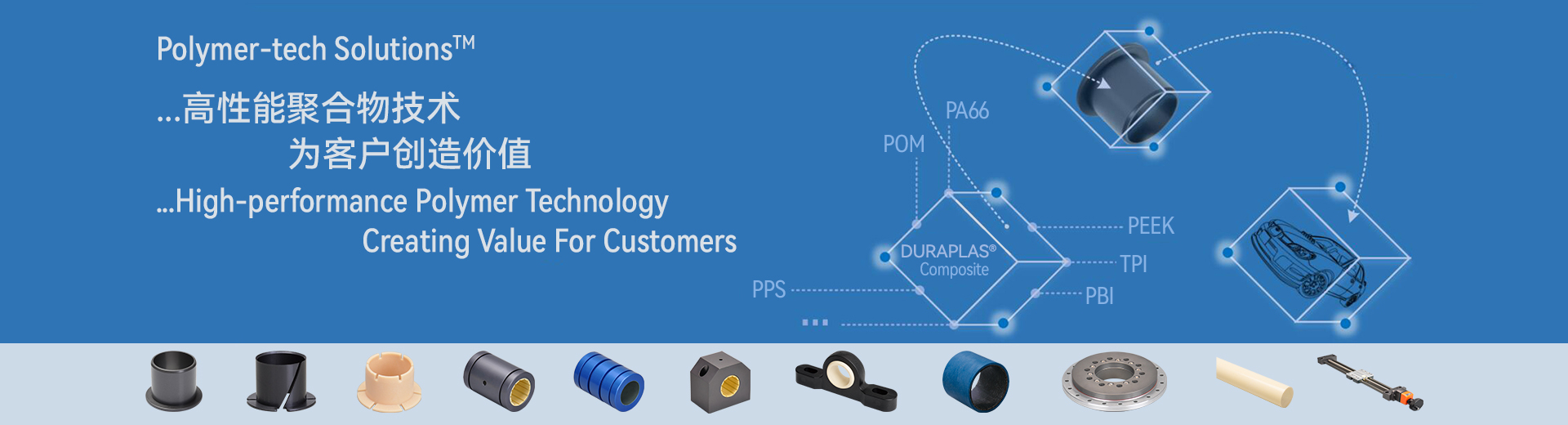
DURAPLAS® semi-finished products are self-lubricating composite wear-resistant plates and rods that inherit the low-friction, wear-resistant, lubrication-free, and corrosion-resistant properties of the bearing materials. The product range includes a rich variety of material grades, with different grades adapted to low, medium, and high loads as well as different temperature and media environments. The semi-finished products require no mold opening and support machining—they can be processed into non-standard bushings, sliders, wear-resistant pads, and other custom-shaped parts through turning, milling, and drilling. This product line is suitable for small-batch prototyping and special non-standard dimension components, eliminating mold development cycles and costs and shortening sample delivery lead times. It is commonly used in equipment prototype R&D, small-batch non-standard equipment, and modified equipment. Engineers can directly purchase plates and rods, machine customized wear-resistant components, and quickly complete prototype verification without waiting for custom mold tooling.

27

2026-08

What are the performance features of DURAFILM® polymer coating services, what improvements can they bring to components, and which parts are applicable?

DURAFILM® polymer self-lubricating coatings are sprayed onto the surface of metal components to form a dense, wear-resistant solid lubricating film. The coating's main performance features include a reduced coefficient of friction, extended component wear life, and rust and corrosion prevention, with strong adhesion and compatibility with various metal substrates. Original metal components are prone to wear, galling, and rust during frictional motion; after coating application, no additional grease is required, enabling dry-state self-lubrication. Applicable parts include metal bushings, sliding plates, lead screws, gears, solenoid valve components, hinged pins, and more—not limited to standard bearings. They are widely used in automotive components, hydraulic elements, valves, and precision tooling. Customers' existing metal components can be directly improved in friction and wear performance through coating modification without re-tooling, reducing overall equipment design modification costs.

27

2026-08

How do DURAPLAS® self-lubricating plastic bearings perform in humid and water environments, and how should materials be selected for different water environments?

Selected DURAPLAS® bearing series can be used in humid and water environments, with significant variations in water resistance across different materials. EPB engineering plastic bearings have relatively low water absorption and can be used in clean water and humid environments; ordinary general-purpose plastic bearings may experience dimensional expansion and accelerated wear after water absorption, making them unsuitable for long-term immersion. DURARUB® filament-wound bearings offer excellent seawater and salt spray resistance; TEFPLAS® fluoroplastic bearings absorb almost no water and resist all types of water quality and chemical media. For clean-water spray equipment, the EPB series is recommended; for seawater and high-salt-spray outdoor conditions, filament-wound bearings are preferred; for water containing chemical agents, TEFPLAS® fluoroplastic bearings should be selected. Application scenarios include water treatment equipment, cleaning equipment, and marine outdoor equipment. During selection, water quality composition, immersion duration, temperature, and load should be provided to confirm the appropriate grade and avoid failure risks caused by water absorption expansion.

27

2026-08

When no corresponding standard bearing model is available, what customized solutions can DURAPLAS® provide, and what operating condition information is required for customization?

DURAPLAS® supports full-chain customized wear-resistant component solutions, including material formulation adjustment, non-standard structural design, and dimensional customization, while also providing life verification and sample testing services. In addition to customized bearing bushings and sliders, supporting services such as DURAFILM® coating processing and semi-finished product customization are available. Customized products inherit the core performance of mass-produced products—self-lubrication, wear resistance, and corrosion resistance—and are optimized for customers' specific operating conditions. When submitting customization requests, customers need to provide operating condition parameters including load magnitude, motion type (rotation/oscillation/linear), operating speed, working temperature, contact media, expected service life, and installation boundary dimensions. Customization is commonly used in special equipment, robotics, and high-end dedicated machinery, where standard parts cannot meet boundary conditions and customized solutions resolve overall equipment friction and wear challenges.


Navigation

Asia
Name:Anna
Tel.:+86-573-84187672
E-mail:sales02@csb-ep.com

Europe
Name:Belle
Tel.:+86-573-84187009
E-mail:sales01@csb-ep.com

Oceania
Name:Anna
Tel.:+86-573-84187672
E-mail:sales02@csb-ep.com

South America
Name:Belle
Tel.:+86-573-84187009
E-mail:sales01@csb-ep.com

North America
Name:Belle
Tel.:+86-573-84187009
E-mail:sales01@csb-ep.com

Middle East
Name:Anna
Tel.:+86-573-84187672
E-mail:sales02@csb-ep.com

Africa
Name:Anna
Tel.:+86-573-84187672
E-mail:sales02@csb-ep.com

CSB in Germany

E-mail:info@csb-gleitlager.de

CSB in France

E-mail:p.mouclier@csb-bearings.fr

CSB PLASTIC in Russia

E-mail:Russia@csb-ep.com

CSB PLASTIC in America

E-mail:America@csb-ep.com

CSB PLASTIC in Australia

E-mail:Australia@csb-ep.com

CSB PLASTIC in Finland

E-mail:Finland@csb-ep.com

CSB PLASTIC in Italy

E-mail:Italy@csb-ep.com