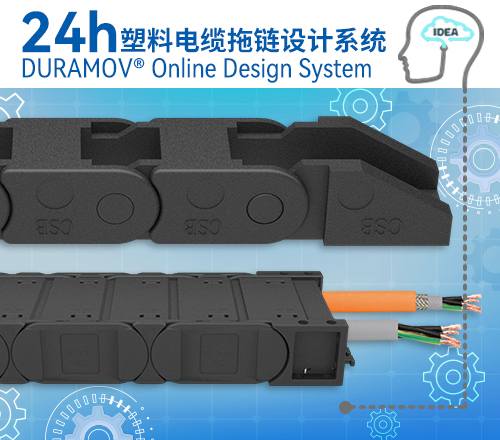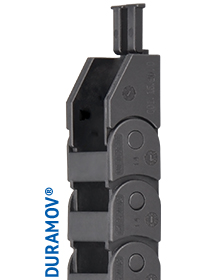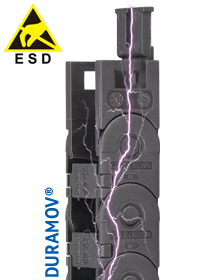
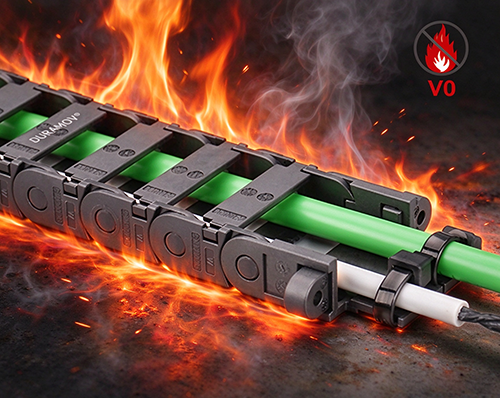
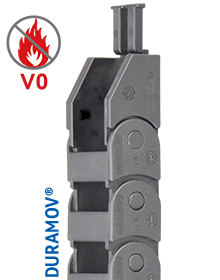
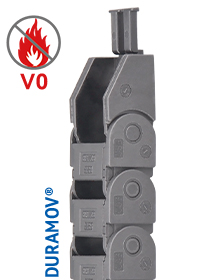
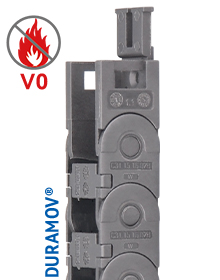
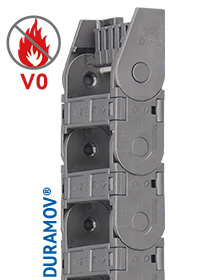
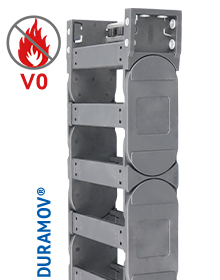
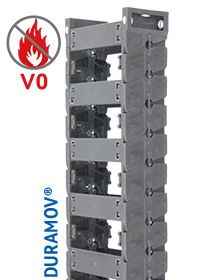
DURAMOV® flame-retardant cable chains are dynamic cable protection products developed by CSB for operating conditions requiring fire safety. Manufactured from modified high-strength, halogen-free and silicone-free flame-retardant plastic, UL94 V‑0 flammability class and comply with RoHS and CE environmental & safety standards. The material self-extinguishes upon removal of the flame and releases no toxic halogen fumes during combustion, mitigating the risk of fire spread.
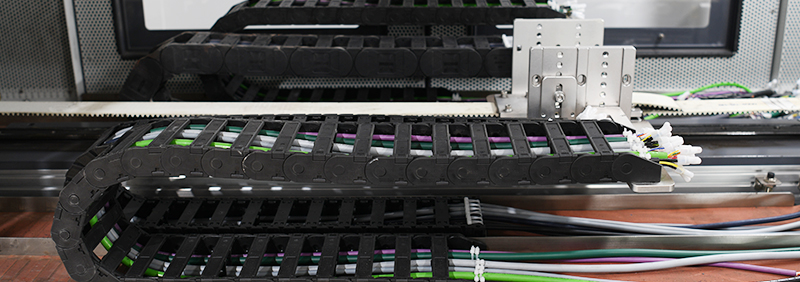
The product portfolio includes six series: C01FR micro integral type, C21FR and C31FR openable micro types, C02FR general-duty type, C03FR heavy-duty type, and C06FR low-noise cleanroom type. The inner height ranges from 7 mm to 80 mm and inner width from 7 mm to 200 mm, covering applications ranging from micro wiring in confined spaces to heavy-load operating conditions. The continuous operating temperature spans from ‑40℃ to +120℃. Its short-pitch structure delivers quiet, smooth reciprocating motion and supports high-speed and high-acceleration operation. Featuring dual-side opening, the chains can be fitted with cable clamps and strain relief components. Compatible with high-flex cables such as servo, power and fieldbus cables, the product balances mechanical strength and fire safety performance.
Compared with conventional nylon cable chains, the core distinction lies in material safety performance. Standard cable chains are mostly made of generic nylon without flame-retardant modification. When exposed to welding spatter, high temperatures or cable short-circuit ignition, they tend to sustain combustion. Burning drips may ignite surrounding materials. They only provide mechanical protection for cables and cannot stop fire propagation. DURAMOV®FR cable chains adopt bulk-modified base material rather than surface-coated flame-retardant paint. Its flame resistance will not degrade due to wear or ageing. While retaining all mechanical advantages of standard cable chains including wear resistance, fatigue resistance, bending resistance and modular assembly, it delivers UL94 V‑0 self-extinguishing fire protection. The halogen-free, silicone-free formulation prevents emission of corrosive toxic fumes that could damage electronic components. It can be directly deployed in cleanrooms and electronics sectors with strict limits on fume and silicone outgassing, filling the gap where ordinary cable chains cannot serve high fire-risk applications.
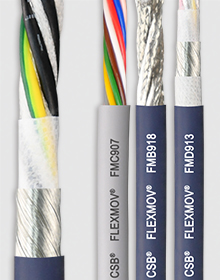
Installation and maintenance guidelines must be followed in field operation to preserve fire resistance and service life. When routing cables, leave a clearance of 10% of cable diameter between cables and 20% clearance for hoses. Use separators to isolate high-voltage and low-voltage cables; bundling cables tightly is prohibited. Arrange cables for balanced weight distribution: place heavy, large cables on the outer side and lighter, thinner cables on the inner side. Both ends of the cables must be secured with matching strain relief components to prevent tensile damage to cable jackets. The selected bend radius shall not be smaller than the cable’s minimum bending requirement. In high-temperature or welding-spatter environments, prolonged direct exposure to open flame is not permitted. The cable chain provides flame retardancy and self-extinguishing capability only and cannot withstand continuous high-temperature burning. Inspect link wear periodically. Severe link wear depletes internal flame-retardant constituents and reduces fire performance; worn components must be replaced promptly. For full-system fire protection, matching flame-retardant cable chain cables are recommended.
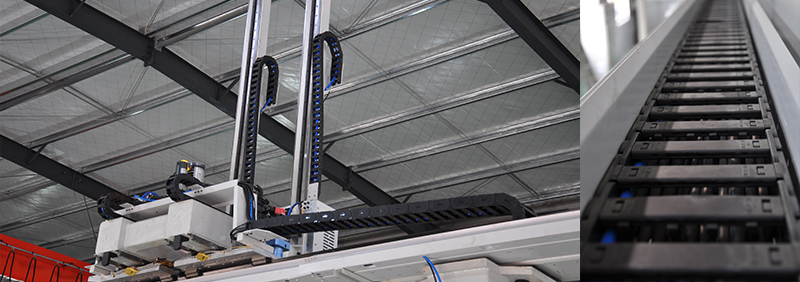
DURAMOV® flame-retardant cable chains are widely adopted in automated production lines with fire safety requirements. In automotive welding lines and welding robots, they resist welding spatter and reduce ignition hazards. In new-energy lithium battery equipment and energy-storage automated stations, they address risks of high-voltage cable short-circuit ignition and block fire propagation. The C06FR low-noise variant is suitable for cleanrooms and precision instrumentation, combining low noise, low outgassing and flame safety. Additional use cases include CNC machine tools, logistics sorting systems, coating lines and robot 7th axes. During high-speed cyclic reciprocation, the chain protects cables against bending failure and slows flame spread in case of fire hazards, reducing risks of equipment burnout and production downtime. It serves as a critical component for fire-safe cable routing systems in industrial automation.