 Polymer-tech SolutionsTM
Against the backdrop of accelerated global energy transition toward clean and low-carbon power, photovoltaic power generation has become the mainstay of newly installed power capacity. As power plants worldwide shift from capacity expansion to power generation efficiency improvement, solar trackers are growing in importance. Compared with fixed mounting structures, solar trackers keep photovoltaic modules aligned with sunlight in real time to extend effective illumination duration. Under the same installed capacity, trackers typically boost power output by 20%~30%, with higher gains in regions with ample solar irradiance and higher latitudes. For this reason, solar trackers have seen rising adoption in large ground-mounted power stations, hilly terrains and Gobi desert projects. The reliability of core transmission and load-bearing components directly determines 25-year lifecycle power generation revenue and O&M costs of the whole plant.
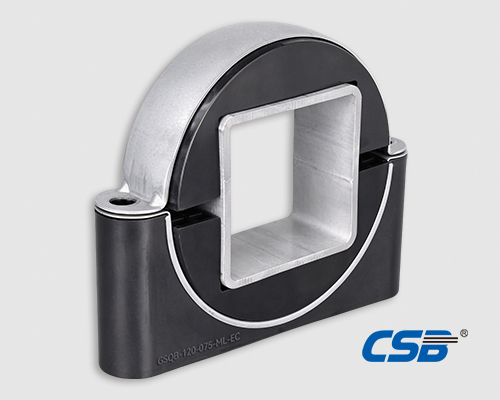
As the critical joint for pitch movement and load bearing of trackers, spherical bearings operate under long-term exposure to harsh outdoor conditions including intense UV radiation, extreme temperature cycles and humid environments. Wear failure will lead to shutdowns and expensive replacement costs. Based on in-depth understanding of real-world tracker operating conditions, CSB® officially releases the GSQB-ML-EC low-profile economical spherical bearing for solar trackers, featuring three key upgrades over the standard GSQB model:
First, reduced overall height to save installation space. The GSQB-ML-EC adopts a low-profile design with noticeably lower overall height versus the standard version. It effectively saves installation space in applications with limited clearance under main beams and compact layout requirements, leaving more room for structural optimization and lightweighting of tracker frames. It also cuts material consumption and overall cost, meeting the demand for power plant cost reduction.
Second, upgraded friction pair materials for extended service life. The standard GSQB uses plastic-on-plastic friction pair for both ball and base. The GSQB-ML-EC integrates a metal liner, transforming the friction configuration into plastic ball against metal liner. The metal liner delivers superior wear resistance and stable friction properties. Under frequent reciprocating swing cycles, it achieves lower wear and longer service life, providing solid guarantee for 25-year maintenance-free operation of solar trackers.
Third, eliminated stick-slip noise risk and improved running smoothness. Plastic-on-plastic contact tends to trigger stick-slip phenomenon under low speed and heavy load conditions, resulting in abnormal noise and crawling motion. The metal liner friction pair adopted by GSQB-ML-EC successfully avoids this problem. The tracker maintains stable, quiet and low-resistance movement during daily tracking cycles, protecting equipment and improving overall power station operation quality.
The GSQB-ML-EC inherits and enhances the split design of the GSQB family: both the inner ball and outer bearing housing are split for rapid on-site assembly. The top cover is reinforced by a galvanized steel hoop to effectively resist radial tension induced by reverse wind load on bearings. In terms of materials, the inner ball is manufactured from PFAS-free, corrosion-resistant and UV-stabilized friction-optimized composite DURAPLAS®MN527. The bearing housing is made of high-strength, UV-resistant PFAS-free composite DURAPLAS®M163. The steel hoop and friction liner are high-strength galvanized steel, delivering self-lubricating and maintenance-free performance while maintaining structural integrity.
The product boasts outstanding performance metrics: up to 9° angular compensation automatically accommodates square tube inclination, especially suitable for inclined tracker frames to reduce site construction difficulty and improve installation efficiency. Its radial load capacity reaches ≥50kN to meet heavy-load requirements of trackers equipped with large-format PV modules. For weathering resistance, the product has passed rigorous aging tests per ISO 4892-3-2016 with total irradiation of 45kWh over 4000 hours, demonstrating excellent resistance to outdoor UV exposure, high/low temperature and humidity cycling.
Targeting on-site construction efficiency pain points, the integrated bearing housing of GSQB-ML-EC only requires two bolts to fasten onto mounting bases for quick assembly and cost-effective deployment. The recommended assembly sequence is straightforward: mount base plate → fit lower housing and lower ball and align holes → install square tube → remove positioning bolts → fit upper ball and steel hoop → tighten with M16×2 bolts. CSB® recommends tightening torque of 100~120N·m, with maximum torque capped at 146N·m to ensure consistent installation quality. With two-bolt fast mounting and up to 9° angular compensation, the bearing adapts seamlessly to flat ground, slopes and mountainous sites, cutting installation complexity and construction costs across various terrains.
With rising penetration of solar trackers and growing focus on levelized cost of energy (LCOE) across the full lifecycle, GSQB-ML-EC combines low-profile form factor, economy and long service life enabled by metal liner. It delivers a spherical bearing solution balancing performance, durability and cost for solar trackers. Backed by CSB®’s mature material technology and 25-year service life guarantee, this new product further optimizes the trade-off between high power generation gain and low O&M expenditure for solar trackers, providing reliable support for high-quality and sustainable operation of global photovoltaic power plants.